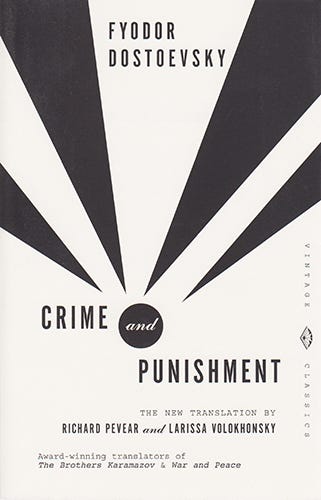
Wanting to read all of the things, and needing to get away from books that touch too close to current events, I thought I’d visit my Russian literature “to do” list. Crime and Punishment has been parsed, studied, and discussed a lot. Summaries abound. Having been around so long, I thought it would be a nice break from now.
The basic premise: a young intellectual comes up with the idea that some people have greatness in them and that the rules of morality do not apply to those people if the rules would keep them from achieving their potential. He ‘stans’ Napoleon. The book opens with him applying this theory to himself and killing a woman to whom he owes money as he is a broke student and this debt stands in the way of his own great potential. He also kills her daughter because he is a clumsy murderer and she walks in on it.
The bulk of the book is what happens after the murder as he carries this secret and the law investigates the crime.
This description of the book is obviously very simplified. As I noted above, summaries abound.

Spoilers ahead…
My copy is the Richard Peaver and Larissa Volokhonsky translation and I recommend it. Comparing the text to another popular translation that was available in digital format, I found the wording in this edition to be more nuanced. Peaver and Volokhonsky also include footnotes throughout the text that explain the context of references Dostoevsky makes to popular ideas and writing of the time. They give information about class structure, geography of the city, and all sorts of other cultural things that enrich the text all these years later.
That said, I did not enjoy reading this book. I was prepared for long description, verbosity, and all the things that come along with reading Russian literature, dialogue of characters set centuries ago, and translated text to top it off. (Spoiler alert coming up, if those apply to books this old.)
However, I was not prepared for an anti-hero so irritating. To spend 800 pages disliking the main character more and more, and then never see a change that makes him at all redeemable? Ugh.
It’s been a decade or so since I’ve read any of the Russian classics. I also know that no writer is another at any time in history. I may have enjoyed Tolstoy back then because: Tolstoy… but I’m wondering now if I wouldn’t love Tolstoy today because no reader is the same person ten years apart in their own history.
In any case, I angry read for many pages just to get this book done. Correction, to be done. There was just no emotional payoff. My ungracious summary of this book is: hundreds of pages of a young, angry man so self-involved that he makes everyone who loves him miserable and turns himself in for murder not because he has any conscience about the two women he killed but because he can’t stand the worry of getting caught, losing his pride, and also to have a shorter sentence based on being a white man with a whole future in front of him.
He drags good people down with him. Sees his selfish crime of murder as on the same level as a young woman who goes into sex work to provide for her impoverished family.
Prior to reading, I’d seen this book repeatedly described as “a portrayal of a guilty man.” This book did not strike me as a deep dive into the psychological struggle with guilt, or morality, or regret. In the last pages, Dostoevsky explicitly writes that his anti-hero still doesn’t feel bad for murdering his intended victim. I see this book as the portrayal of a man guilty of a crime but who feels no guilt at all. It is a narrative of a deeply narcissistic individual afraid of getting caught for a crime he doesn’t regret beyond its impact on himself, set against the backdrop of women suffering the harms of class structure and patriarchy.

Before closing, I’ll say I’m not holding personal beef with Dostoevsky. I may try other books of his one day. I see him as a product of things that were and that remain. Like his unlikeable anti-hero, my own head of government quoted the same Napoleonic suggestion of being above the law just the week I’m drafting this. Looking back on it, my attempt to get away from current events by going far back in time was a laughable mistake when history is so blatantly repeating itself. With that, I’ll turn from this literary period and dive into some different reading and very different authors.
-HR
Purchase link:
No affiliation. Just a shopper.



 Hard Return